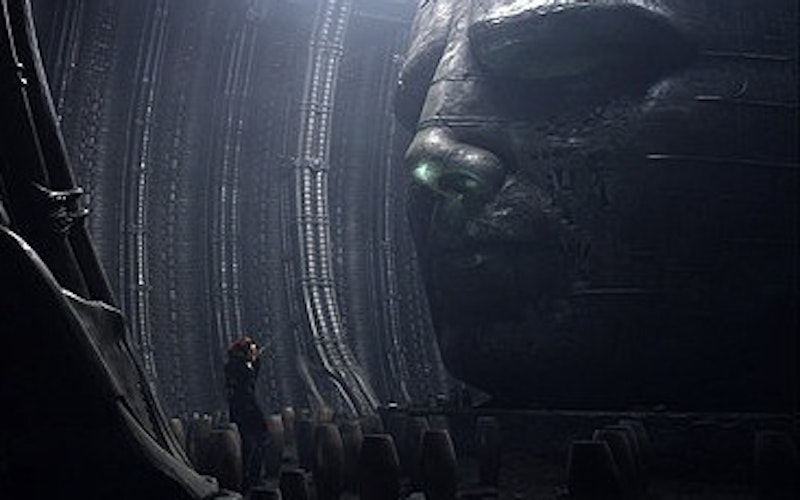
Often referenced by Alfred Hitchcock when discussing filmmaking technique, a MacGuffin is an object that exists solely to set a movie’s plot in motion. The title statue of The Maltese Falcon is perhaps the most famous example.
Prometheus, the new prequel to 1979’s Alien, has a MacGuffin too, and it’s God. Though the movie’s predecessor was an unassuming horror flick, Prometheus has ambitions worthy of its title: it doesn't want to be a thrill ride but rather a piece of deep-think sci-fi. And so what better way to do that than raise questions of creation, faith and eternal life?
Set some 30 years before Alien, in which the crew of a towing spaceship does battle with one of cinema’s nastiest creatures, Prometheus aims to explore the origin of the beast. It follows a team of scientists who have detected evidence of life on a distant planet. When they arrive, they come across artifacts and other elements that will be familiar to fans of the four-film Alien franchise.
Among these scientists is a geologist (Noomi Rapace) who wears a cross and believes the planet will reveal the origin of human life, if not God himself. She’s referred to as a “believer” and towards the end, after the planet is revealed to be far more menacing (and gooey) than she expected, she’s asked, “Even after all this, you still believe?" The movie tosses around a lot of dialogue like this, yet the notions behind the words are never explored in any serious way. Prometheus purports to be about big ideas, but if you’re really curious about something, you do more than mention it.
This was also a weakness of the television series “Lost,” which by its end had literally landed in a hazy purgatory. It’s not a coincidence that “Lost” co-creator Damon Lindelof is a screenwriter and executive producer on Prometheus. Words like “belief” and “faith” and “skeptic” were thrown around a lot on that show too. And, as in Prometheus, they never added up to much. Mostly they’re used to evoke an aura of meaningfulness, a vague sort of spirituality. In Prometheus in particular, they function as intellectual ornaments hung on an elegantly designed, Ridley Scott-directed tree.
As a whole, Prometheus evokes a lot more than it explores (spoilers ahead). It’s a movie of what-ifs, interested in posing “mind-blowing” questions but not investigating the implications. What if the creature from Alien was created by another extra-terrestrial race? And what if humans and this race had met before? Indeed, what if they made us? The movie keeps suggesting such possibilities, without ever letting any one of them settle into a narrative of forward momentum.
This is, ultimately, a movie of multiplying MacGuffins, with God being one. There’s nothing heretical about that (He’s been called far worse), but for those of us genuinely interested in science and faith – and deep-think sci-fi that really digs into both - Prometheus is a shallow exercise.
What Do You Think?
- What did you make of how Prometheus handled its spiritual themes?
- What science-fiction films have best explored matters of faith?
- Can you think of other examples of God being used as a MacGuffin?


Leave a comment
A login account is required to leave a comment
Alternate Login
Use your social media account to login.
Login with your ReFrame account
Comments (11)
That said, I do hope you stick with us and come back after you've seen Prometheus. We'd love to hear what you make of it.
Thanks for the review. pvk
Then read your article...
Now that I've thought about it I do realize that it was shallow in not exploring Dr. Shaw's faith and really delving into her fight of faith vs science. I did guess on my own that she is fighting and alot of that drive comes from the death of her parents, searching for meaning to their lives and death and purpose for her own, but I'm speculating.
One theme I did find interesting is the idea of evolution of creation vs. Creator. David the android was created by us and was assumed to have no feelings, but he acted with a motivation and motive. Bring up the question of his evolution. He even seemed hurt to hear the idea of not having a soul or liked hearing he was like a son. These "engineers" created us, then created a biological weapon to destroy us. One could guess they became afraid that their creation would one day turn on them and so try to kill us only their second creation ended up killing them. Much like our creation - David - ending killing Dr. Halloway.
The problem is it brings up these themes and ideas and never really anchors to any of them.. I assume to give more leeway for the next installment. But still if you're gonna spend big bucks, make a good looking movie and draw me to the theatre at least blow my mind a bit more...
As for why the Engineers hate us, I found this to be the best explanation (SPOILER!?):
"The reason the Engineers don't like us any more is that they made us a Space Jesus, and we broke him."
http://is.gd/NRukzk
I guess the "forgive them for they know not what they do" didn't get communicated skyward.
Nope! Sorry! That's inaccurate. As a fan of the show, and how it ended, I can honestly say that it never ceases to shock me that two years later so many people are still confused about this.
Purgatory, by its very definition, is "the condition of purification or temporary punishment by which those who die in a state of grace are believed to be made ready for Heaven." (Thanks, Wikipedia.) Where is the evidence in the show itself implying that the folks in the Sideways World walked into the light and entered Heaven? Yes, the SW was a place for moving on and letting go--but to call it purgatory sells short the deftly woven narrative of redemption, self-sacrifice, and struggle that made LOST so special.
The interpretation that is much more in keeping with the actual canon of the show is that the "light" in the church was actually that of The Source. That's what "letting go" is truly about--forgiving yourself and returning to The Source in a state of peace so the cycle of creation can begin anew. There's nothing religious about this whatsoever.
And yes, this *is* all a "vague sense of spirituality," due to the fact that it represented the journeys of many different characters with many separate belief systems and past transgressions. If you were waiting for LOST to own up to being purely "spiritual," especially in any sort of Christian sense, then you were watching the wrong show. The same goes for Prometheus--I think the movie was fairly clear in its proclamation that there is no God. And of course Shaw’s "Christian beliefs" are shaky at best, because she's clinging to her faith as a way to stay connected to her father. If she truly had faith she wouldn’t want answers about her creator so desperately in the first place, now would she?
If I see any underlying theme between LOST and Prometheus that can be pinned on Mr. Lindelof, it's the interpretation that life can be created without God at all. It’s right there in the movie—the Engineers made life on Earth, and that making is mirrored in Weyland’s creation of David. ... A far superior specimen to humans, IMO. ;) ... And this theme can be found in LOST, too--creation comes from a freaking plugged hole in a cave on a mysterious island! In the LOST universe, individuals can find redemption by forgiving themselves, and through loving one another, and from believing in something that is bigger than all of them. God is not part of either equation--it's just the word we commonly use to describe something that is beyond the scope of our imaginations.
But does that make the specter of God in either LOST or Prometheus a MacGuffin? I would say only if you're looking for something that was never there in the first place.
I don’t look for God in every movie or need Him to be a presence in a movie for me to appreciate it, but your comment does make me wonder if, as a Christian, I’m not as open to other religious (or irreligious) narratives as I should be. This isn’t a problem for me when it comes to drastically “unchristian” stories – Uncle Boonmee Who Can Recall His Past Lives, for instance – but I can see that it might trip me up when a movie like Prometheus plays with Christian ideas. In the end, I guess you’re saying the filmmakers behind Prometheus are playing with them to refute them, which would be interesting to me. Unfortunately, I felt they didn’t really put much effort into understanding the Christian elements beyond the surface level (that cross necklace is so lazy), so it’s hard to take any refutation seriously.
Josh, can I assume by God you meant a creator? Because the movie never explicit uses God, or a God.. its all about where we came from - how we were created. So in my mind I use them interchangeably and I'm assuming you did as well. If so then I would disagree with Elissa because finding a creator is exactly why this movie started in the first place. Elizabeth Shaw was desperate to find her creator and ask the big questions but was left with more questions then answers and I suppose thats they way it will always be until we are standing before The Creator and if in that moment we feel like asking we can ask all about creation.
I never watched a full episode of LOST, never wanted to and I probably never will. So really I can't really argue about the show and its intentions and what it tried to say about God or spirituality. I will say this, Hollywood is notorious for playing around with spirituality, probing questions and not really answering them, leaving hints here and there but never really coming to a definitive conclusion. Its smart because it creates buzz and gets us talking and the creators of any show or movie never have to arrive at a definitive conclusion or push their beliefs on anyone. I think this is similar to Prometheus. It played around with things, did a preliminary check of ideas and thoughts but it never even tried to really dig deep. I agree the cross was so lazy at one point I asked myself why it played such a prominent role in the movie because it feels out of touch with a character who barely mentions her beliefs and if they are Christian at all. I feel like creator/creation/God was the MacGuffin but beyond that (except for the cross and one line that Halloway says about creating life) the movie does a poor job of going deeper and that was probably the intent.
Leave a Comment »